          ;   :   ;
   .   \_,!,_/   ,
    `.,'     `.,'
     /         \
~ -- :         : -- ~
     \         /
    ,'`._   _.'`.
   '   / `!` \   `
      ;   :   ;
          .-~~~-.
  .- ~ ~-(       )_ _
 /                     ~ -.
|                           \
 \                         .'
   ~- . _____________ . -~
Letters And Pencils
I love papers: posters, booklets, packages from sugar, stickers; the list is endless. And more than that, I love sending them to my friends in letters. Pablo, in turn, loves pencils. He always has one or two with him and prefers them to pens. In fact, seeing Pablo with a pencil and a notebook was one of my first memories of him. That is why, when I saw the open call in the Pencil Magazine for their letter-writing issue, this was a no-brainer - we took out our pencils and metaphors and started creating a magazine spread. The result was included in the issue, and I am also sharing it here.
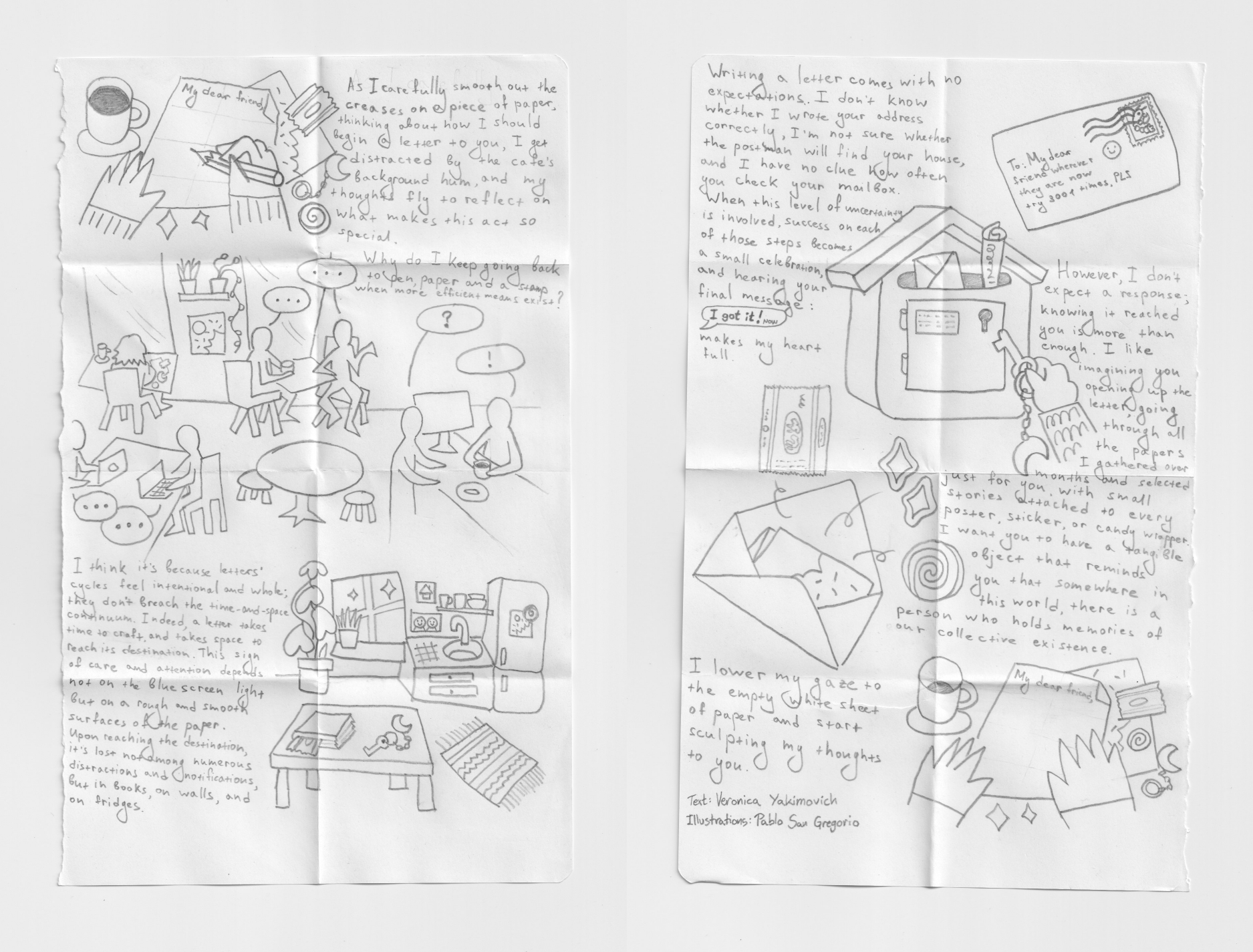
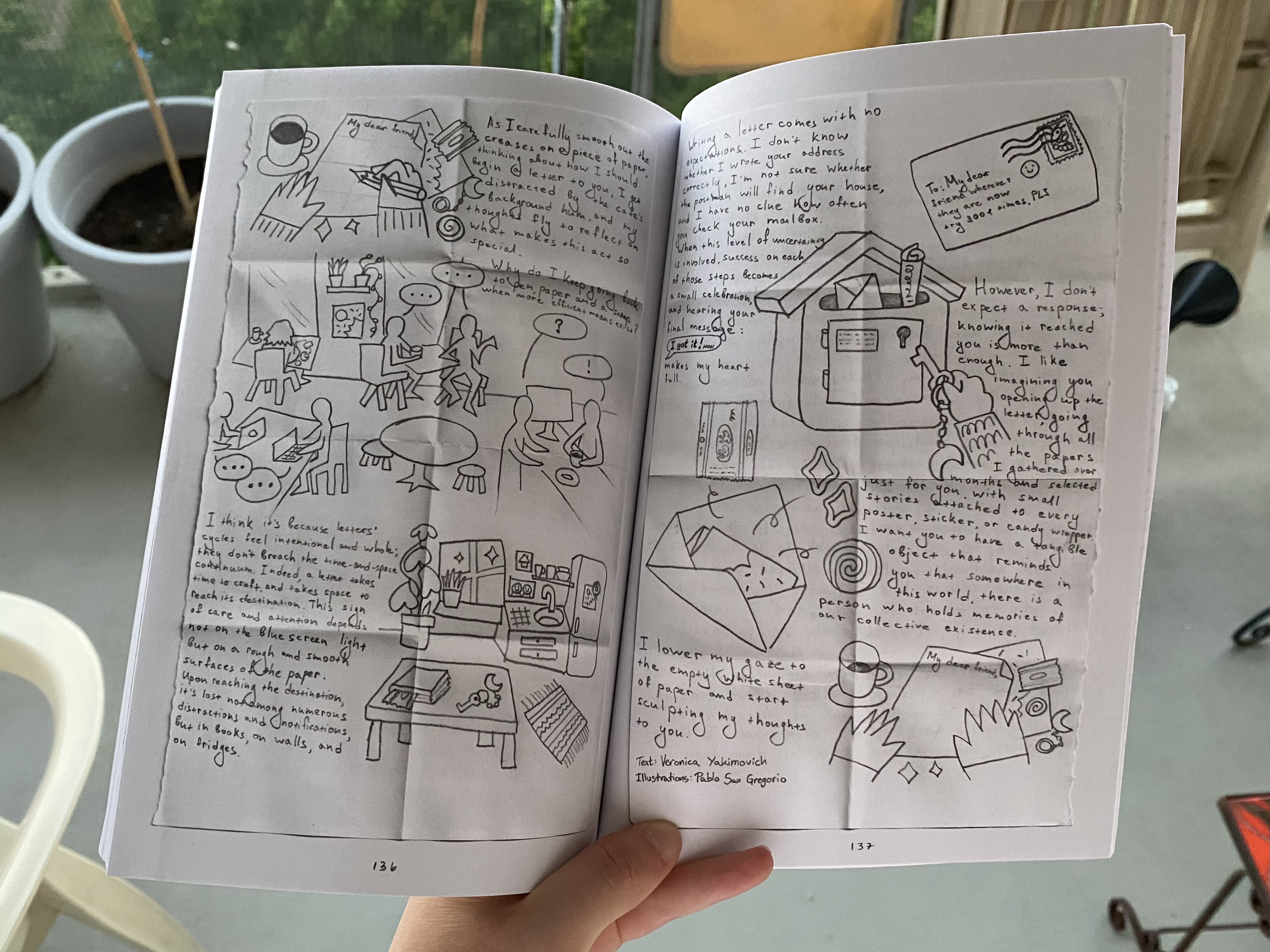
This whole process of crafting a text, thinking about accompanying images, contemplating the format, receiving the magazine by post, and finally flipping together through the physical printed version was such a magical experience! To get a full taste, we even went to a bookstore in Amsterdam to see it on sale physically (in the end, they only had previous Pencil Magazine issues, but the little adventure was nice).
Even though I was already involved in the human rights letter-writing initiative, my personal habit for writing letters to friends fully flourished after I received a letter from my friend J. The letter was discovered in my mailbox after a year or so of lying there, as I did not have a habit of checking it. This act of care brought me so much happiness that, since then, it has become routine to craft tangible messages to friends kilometres away. In addition to that, I have been trying to find ways of carefully preserving and archiving (both digitally and physically) postcards, notes, drawings, zines, stickers I received from close ones that are far.
To present this enthusiasm of mine on this website, I also wanted to somehow connect it to the topic of infrastructure, and that is how a curiosity emerged: What happens to my letters after I send them? What infrastructure allows my letters (more often than not) to reach their destination?
First, I found a couple of videos from almost 10 years ago showing what the letter-sorting office looks like from the inside: one shows the UK post office, another the Hong Kong one. Both counties’ offices worked fairly similar, especially in the proportion of human vs machine labour behind-the-scenes. What I noticed is that postal sorting machines did not replace human labour, but reoriented it, often to accommodate the machine’s work. For example, this video is about the offices in the US where people work to decipher the handwriting that machines could not.
Perhaps the most intriguing fact I learned was about the existence of the Universal Postal Union. This video, though made in a somewhat sensationalist YouTube style, was an entry point into the fascinating world of international postal regulation. The Union’s mission is to ensure postal services worldwide understand where a letter is going and are paid for their work. It does so by coordinating a huge spreadsheet that contains ALL international mail routes and the price of a letter to get there, calculated in SDR (an international reserve asset - another rabbit hole you can dive into). Without such universal coordination, if you were to send a letter from Riga to Mexico City, you would have to affix a stamp for every country through which your letter passes.
The Universal Postal Union even has a podcast :) I listened to this short episode about the challenges postal policymakers face due to the growing influence of e-commerce platforms, and how the postal industry is shifting its focus from letters to parcels.
Finally, outside my targeted exploration of the postal systems, I listened to the podcast about how officials in the US contemplated nuclear annihilation during the Cold War (heads up in case you want to listen, the podcast is heavily US-context-centered). The episode mainly focuses on how they decided which items to preserve in such a scenario. But there was a brief segment on how to count who stayed alive in case of nuclear bombings. The strategy was to send out postcards that were supposed to be returned to the sender in order to track who had survived the explosion. After all, the postal office has the database of all households. Postal services undoubtedly play an important role in global events, but this example also showed that not only their functions but also their tools and methods (namely, documentation) can be strategically important. I also liked this parallel between letters and, to some extent, the topic of my MA thesis (which I’ll write about later).