          ;   :   ;
   .   \_,!,_/   ,
    `.,'     `.,'
     /         \
~ -- :         : -- ~
     \         /
    ,'`._   _.'`.
   '   / `!` \   `
      ;   :   ;
          .-~~~-.
  .- ~ ~-(       )_ _
 /                     ~ -.
|                           \
 \                         .'
   ~- . _____________ . -~
On Frictions And Inconveniences
Coming back to Kaunas for a few months, the city I have been running away from and loyally coming back to, I did not have any expectation to be surprised this time. I made friends with the city four years ago, and since our first encounter, curiosity has led me to the most unexpected places, and gradually the picture I painted of the city in my head has seemed coherent and precise.
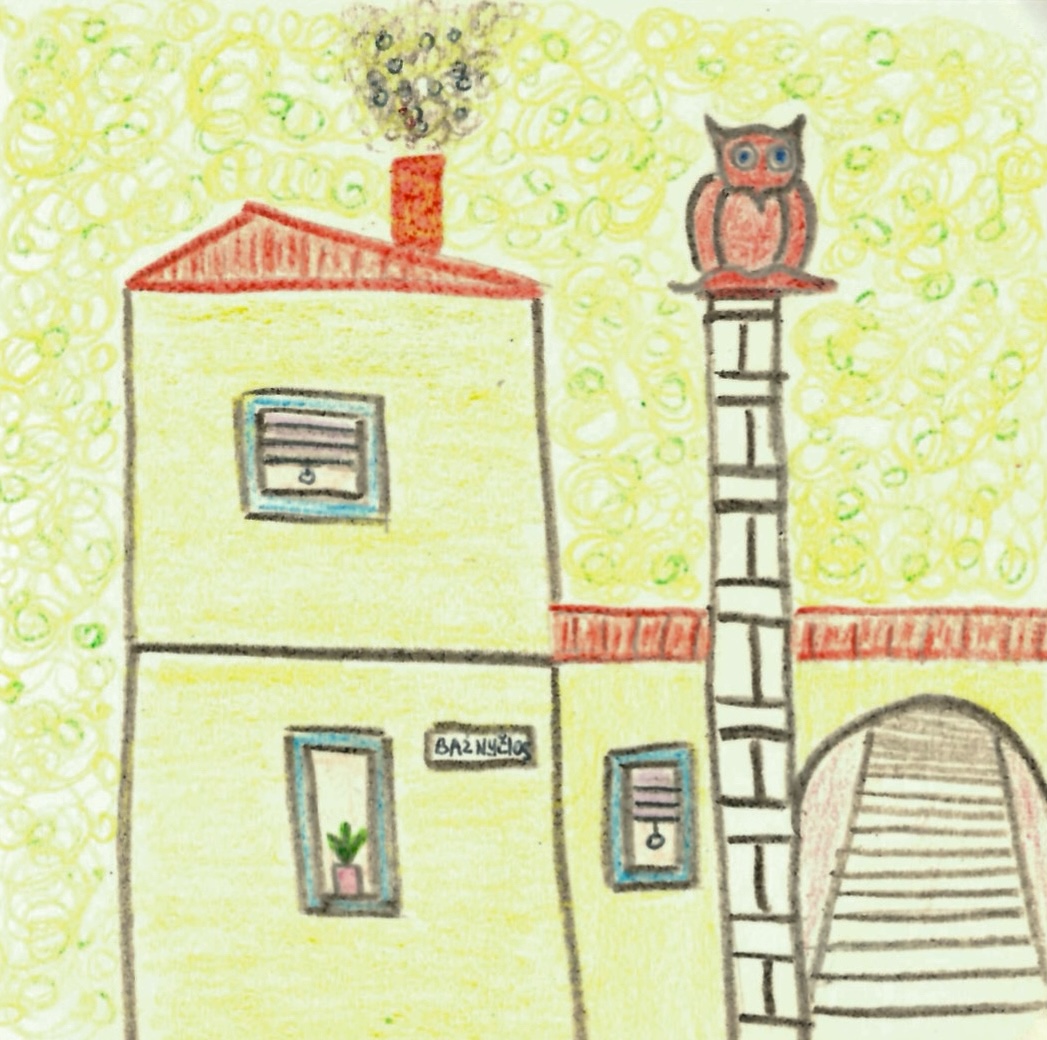
Yet, no matter how well you know the city’s layers in broad strokes, only by encountering spaces on a routine basis do they open up their smooth and spiky corners in their fullest to you. Each temporary rental apartment I lived in showed me one piece of localness that was later woven into the patchwork of what I now know as Kaunas. While living in a flat close to the railroad, I discovered a hidden public staircase that led through the arch with an owl sculpture on top, up among the vegetable gardens and houses maintaining balance on the hillside. When climbing these stairs during late autumn and early spring, the surrounding trees were permissibly showing me the panoramic view of Kaunas’ roofs.
Reaching another home by the bridge across the Nemunas River, I was convincing myself I was not scared of heights while cars sped past me by my side. But it is exactly that bridge that made me see the lush flora slowly conquering the riverside, otherwise hidden from the other shore’s view. The scale of the unconstrained greenery had such a loud presence that it perplexed me why I was the only one standing in fascination at that moment.
This time with P., our temporary shelter stood on a noisy road, which was especially noticeable on warm Friday evenings, when motorcyclists had their moment by removing the baffles from their vehicles. From being an annoyance, the steady sound of the road soon served as a lullaby, masking the unpredictable noises of the neighbours. A few weeks later, the noise turned into a barely noticeable dullness, even pleasant at times, as it reminded me that the surroundings are alive. And although, in general, I would have preferred other sounds to accompany me, at times it was exactly that friction that helped me stay connected with my environment and not feel painfully detached from the life around me. At the same time, the very idea of adjustment and finding pleasure in such friction frustrated me.
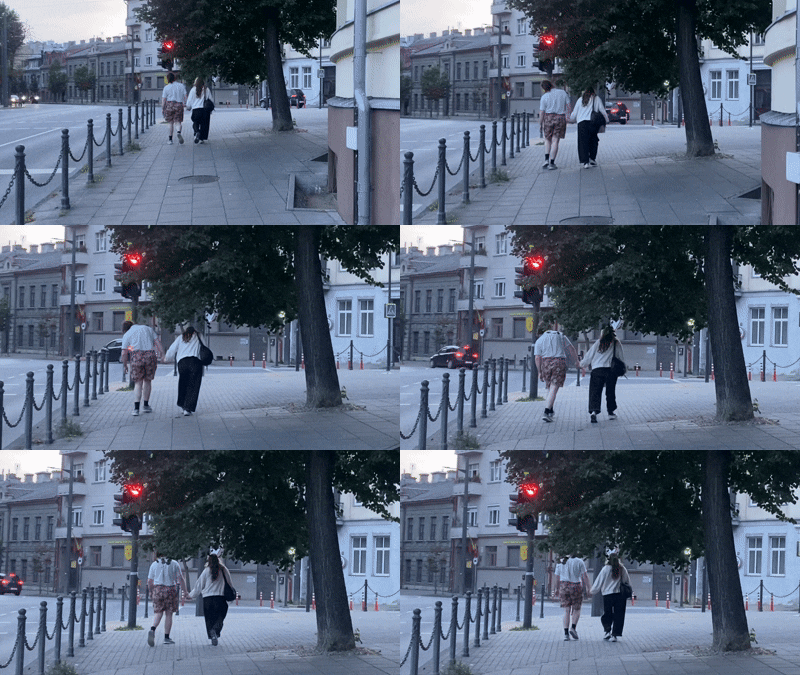
The concept of friction in urban spaces came back to me again as, together with P., we routinely strolled down the pedestrian pass in one of the central streets in Kaunas. It might have been a regular pavement if not for the huge tree standing right in the middle of the path blocking off the way and making no sense from a convenience standpoint. More than that, the tree’s branches descended to the level where you needed to slightly crouch to pass. It might have been dismissed as a simple case of more-or-less unfriendly urban planning, yet the fact that this was a huge tree, not taken down and left in such a clumsy position that it became a ‘just enough’ nuisance for passers-by, made me think about the positive side of such inconvenience. Indeed, passing under this tree every time evoked a sense of joyfulness, sparking small talk about how funny its position was. In a way, it made us come back from the level of our thoughts to the level of our surroundings and the entities that inhabited them.
The weird pleasure of the inconvenience this tree has caused us has inspired me to dig deeper into what has already been written about friction. Where friction tips the point and becomes hostile, and where, on the contrary, the strive for smoothness of our interactions with the urban landscape has gone too far. After all, if instead of the tree there had been a concrete fence, we would most likely have reacted differently. Yet without the tree at all, there would not have been any fun! I do not aim to present a comprehensive literature overview of the concept of inconvenience, rather, see it as a patchwork of trains of thought that I gathered in the process.
Kristian Kloeckl defined inconvenience as a concept focused on the cracks, slips, and glitches of everyday life. To utilise a physics idea of friction: friction is felt when in motion. And as you move, you are in relation to spaces, objects, sentient beings. This relationality, in turn, opens room for disagreements, doubts, and vulnerabilities along the way. Feelings of discomfort are thus elements of affective infrastructures, they emerge from specific social and political contexts rather than being isolated or individualised.
As Bruce Willen put it, ‘when we sand the sharp edges off of our experiences, it allows us to forget that life is inherently weird and, also, challenging.’ Thus, ‘the inconvenience of the world is at its most confusing when one wants the world but resists some of the costs of wanting’ (Lauren Berlant). Navigating and exploiting this can be frustrating, but just as often, it is wondrous. Berlant wonderfully formulated in her book ‘On the Inconvenience of Other People’:
At a minimum, inconvenience is the force that makes one shift a little while processing the world. It is evident in micro-incidents like a caught glance, a brush on the flesh, the tack of a sound or smell that hits you, an undertone, a semiconscious sense of bodies copresent on the sidewalk, in the world, or on the sidewalk of the world, where many locales may converge in you at once materially and affectively.
In effect, life experiences are too messy to fit authentically into fantasies of borderless convenience and its principles of invisibility, optimisation, frictionlessness, and low maintenance. This can be exemplified by the idea of the smart city, according to which it suffices to ‘oil’ the city machine with real-time data to achieve the desired convenience in operations. In it, citizens are turned into ‘good users,’ following the paths and motions that system designers lay out based on the data extracted from them by whatever means. However, as Sally Whyatt (an STS scholar in my faculty at Maastricht University) mentioned in her farewell lecture, the concept of ‘user’ is reductionist, as it solely emphasises the functional relationship between a person and an object (in her case, technologies), while people relate to objects in many other capacities: as citizens, refugees, patients, passengers, students, and so on.
In this regard, I find the notion of repair being closely connected to the idea of friction. Repair can be seen as an unattractive part of our systems, exposing the limits and fragility of the world, and thus being hidden behind the scenes of the idea of endless growth and progress. And yet, repair is indispensable; it grows ‘at the margins, breakpoints, and interstices of complex sociotechnical systems as they creak, flex, and bend their way through time,’ as Steven J. Jackson formulated.
I should also say that, at first, when I began thinking about and researching the notion of inconvenience, I couldn’t help but ask myself whether it is a great privilege to consider the more positive side of inconvenience; isn’t the world in many ways already uncomfortable enough to strive to retain its sharp edges? Yet, Berlant’s book helped me craft a more defined perspective: it is not a matter of whether inconvenience is positive or negative; it is a matter of how we approach it. Do we try to run away from it, or do we work with and alongside it, acknowledging and understanding what causes it and why, seeing whether it should be done otherwise, and analysing what gets lost if we do? As Berlant wrote:
Our task is not to replace inconvenient objects with better ones but to loosen up the object to reorganize and extend it.
I would like to hear your thoughts, agreements, frictions, inconveniences about the topic. Soon there will be a comment section!